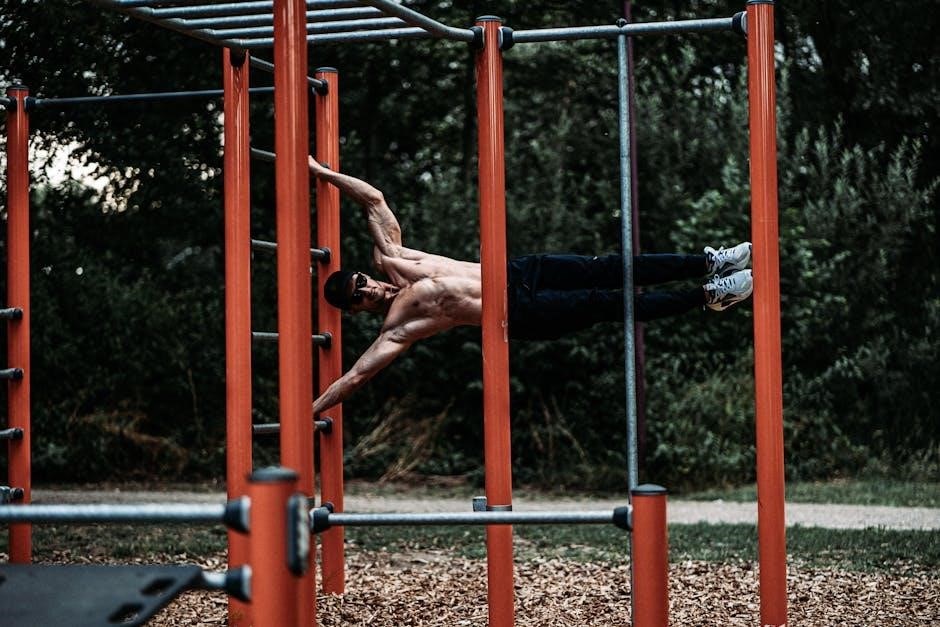
Calisthenics Training Program PDF: A Comprehensive Plan
This meticulously crafted PDF offers a simple, easy-to-follow calisthenics program, drawing upon expertise from renowned figures like Steven Low and Tom Merrick.
It features beginner-friendly routines, handstand progressions, mobility work, and a full-body template, all designed for progressive strength and skill development.
Calisthenics, at its core, is the art of using your own bodyweight as resistance for physical training. This approach has a rich history, evolving from ancient Greek gymnastic exercises to modern fitness practices. A calisthenics training program PDF provides a structured pathway to harness this power, offering routines and progressions accessible to all fitness levels.

Unlike weightlifting, calisthenics minimizes the need for expensive equipment, making it incredibly versatile and convenient. The focus shifts to mastering fundamental movements – pushing, pulling, squatting, hinging, and core stabilization – building functional strength, endurance, and body control.
This PDF program leverages insights from leading calisthenics experts, such as Steven Low and Emmet Louis, integrating proven techniques for optimal results. It’s about building a strong foundation, progressing safely, and ultimately achieving your fitness goals through bodyweight mastery.

What is a Calisthenics Training Program PDF?
A calisthenics training program PDF is a digitally formatted document outlining a structured plan for bodyweight exercise. It’s designed to guide individuals through progressive routines, building strength, skill, and endurance without relying on traditional weights. This particular PDF distinguishes itself by being exceptionally well-made, simple, and easy to follow.
It’s more than just a list of exercises; it’s a comprehensive system incorporating warm-ups, strength work, mobility drills, and periodization strategies. The program draws upon resources from influential figures like Steven Low, Emmet Louis, and Tom Merrick, ensuring a well-rounded and effective approach.
Essentially, it’s a portable, accessible fitness coach, offering a clear roadmap to achieving calisthenics goals, whether you’re a beginner or an advanced practitioner.
Benefits of Using a Calisthenics PDF Program
Utilizing a calisthenics training program PDF offers numerous advantages, primarily convenience and accessibility. Having a structured plan readily available digitally allows for training anywhere, anytime, eliminating the need for gym memberships or bulky equipment. This specific PDF’s simplicity and clarity are major benefits, making it easy to understand and implement, even for beginners.
Furthermore, the program’s foundation in expert knowledge – drawing from Steven Low, Emmet Louis, and Tom Merrick – ensures a safe and effective approach. The inclusion of periodization and deload weeks promotes sustainable progress and prevents plateaus.
It’s a cost-effective and efficient way to achieve fitness goals, fostering a consistent training habit.

Program Components & Structure
The PDF program is built around three core routines: handstand, mobility, and full body, strategically combined for optimal results and progressive overload.
Beginner Routines Included
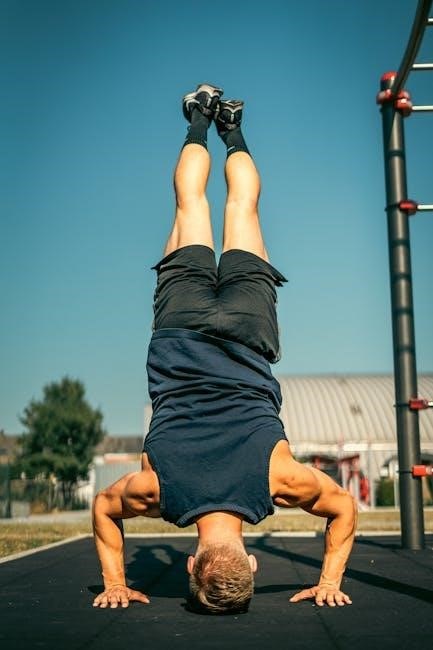
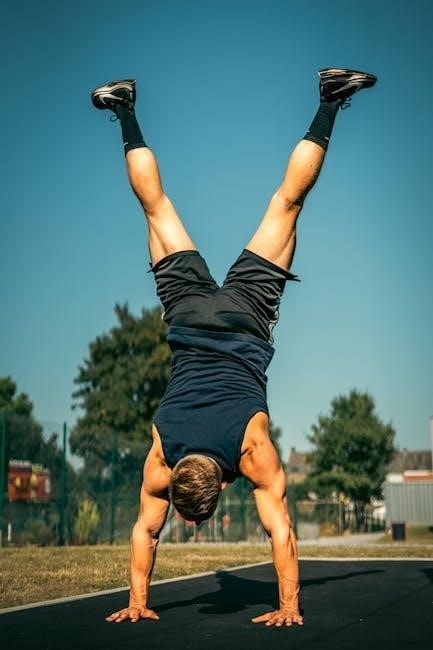
This calisthenics PDF thoughtfully incorporates three distinct routines specifically designed for individuals new to bodyweight training. These routines provide a solid foundation for building strength, improving mobility, and developing fundamental skills. The first is a dedicated Handstand Routine, focusing on shoulder and wrist preparation, alongside essential strength work like handstand holds, L-sits, and bodyline drills.
Complementing this is a comprehensive Mobility Routine, heavily influenced by Tom Merrick’s work, emphasizing dynamic stretching and joint health. Finally, the Full Body Routine utilizes a template mirroring the popular “RR” (Road to Resilience) approach, pairing horizontal and vertical push/pull exercises, alongside anterior and posterior lower body and core work.
These routines are intentionally structured to be accessible and scalable, allowing beginners to progress at their own pace.
Handstand Routine Breakdown
The Handstand Routine within this PDF is meticulously structured to build the necessary strength, stability, and control for achieving and maintaining a handstand. It begins with a focused Warm-up, prioritizing shoulder and wrist preparation to enhance mobility and reduce injury risk. This is followed by targeted Strength Work, incorporating handstand holds themselves, alongside progressive exercises like L-sits and bodyline drills – crucial for developing core engagement and upper body power.
Crucially, the routine doesn’t neglect Handstand Mobility Work, specifically addressing common issues like an arched back, drawing upon Emmet Louis’s recommendations for postural correction. This holistic approach ensures a safe and effective progression towards mastering the handstand.
The routine is designed to be performed consistently, building upon each session to unlock greater handstand proficiency.
Warm-up for Handstands
The handstand warm-up, as detailed in the PDF, is specifically designed to prepare the shoulders and wrists for the demands of inverted training. It’s not a general warm-up, but a targeted sequence to increase blood flow, range of motion, and neuromuscular activation in these key areas.
Expect dynamic stretches focusing on shoulder rotations, scapular protraction and retraction, and wrist circles. These movements prime the joints and muscles, reducing the risk of strain during handstand practice. The warm-up also includes preparatory drills, gently easing the body into positions that mimic handstand mechanics, building confidence and control.
This thorough preparation is essential for maximizing performance and minimizing the potential for injury.
Strength Work for Handstands
The strength component of the handstand routine, as outlined in the PDF, focuses on building the necessary foundational strength to hold and control a handstand position. It’s not solely about handstand practice itself, but about developing supporting muscle groups.
Key exercises include dedicated handstand work, progressing from wall-assisted holds to freestanding attempts. Alongside this, the program incorporates L-sits, a crucial exercise for core stability and shoulder strength, and bodyline drills, which help refine body awareness and alignment.
These exercises work synergistically to build the strength and control required for consistent and safe handstand progression.
Handstand Mobility Work
The handstand mobility section within the PDF program emphasizes maintaining and improving the range of motion necessary for optimal handstand form and injury prevention. It directly addresses common limitations that hinder progress.
A significant portion of this work revisits wrist mobility exercises, recognizing the substantial stress placed on the wrists during handstands. Crucially, the program also incorporates Emmett Louis’s recommendations for correcting an arched back – a frequent issue in handstand attempts.
This targeted approach ensures that practitioners not only build strength but also develop the flexibility and body awareness needed to execute a safe and efficient handstand.
Mobility Routine Details
The mobility routine detailed within this calisthenics PDF program is heavily influenced by Tom Merrick’s comprehensive mobility work, essentially mirroring his well-regarded video content. This provides users with a readily accessible and proven system for enhancing joint health and movement quality.
The routine isn’t solely focused on handstands; it’s a holistic approach to improving overall mobility, benefiting all calisthenics exercises. A core component centers around dedicated wrist mobility exercises, acknowledging the significant demands placed upon them during various movements.
Furthermore, the program integrates Emmett Louis’s insights on addressing and correcting an arched back, a common impediment to proper handstand form.
Wrist Mobility Exercises
The calisthenics PDF program places significant emphasis on wrist mobility, recognizing the crucial role these joints play in numerous exercises, particularly handstands and push-up variations. The routine isn’t just about stretching; it’s about actively preparing the wrists for the stresses of calisthenics training.
Specific exercises are included to address all planes of motion within the wrist joint, enhancing both flexibility and stability. This proactive approach aims to prevent injuries and improve performance.
The program acknowledges that consistent wrist work is essential, not just as a preventative measure, but also as a means of improving technique and maximizing range of motion during challenging movements.
Addressing Arched Back in Handstands
A common challenge for those learning handstands is maintaining a neutral spine, often resulting in an undesirable arched back. This PDF program directly addresses this issue, drawing upon insights from Emmet Louis to provide effective corrective strategies.
The program doesn’t simply tell you to “fix” your back; it offers practical drills and cues to engage the correct muscles. These exercises focus on posterior pelvic tilt and core activation, helping to flatten the lower back and achieve a more stable handstand position.
Emphasis is placed on understanding the root cause of the arch, rather than just masking the symptom.
Full Body Routine Template
The core of this calisthenics PDF lies in its adaptable full-body routine template, designed for consistent, well-rounded development. It mirrors the structure of popular programs like the Road to Resilience (RR), but with a unique pairing approach.
The template emphasizes horizontal and vertical push/pull movements, ensuring balanced muscle engagement. This means pairing exercises like push-ups with rows, and overhead presses with pull-ups.
Furthermore, it incorporates dedicated lower body work, utilizing anterior (lunges) and posterior (hip thrusts) chain exercises. Core training is also included, with anterior (hollow holds) and posterior (arch holds) variations.
Warm-up for Full Body Training
Prior to initiating the full-body routine, a comprehensive warm-up is crucial for preparing muscles and joints, minimizing injury risk, and maximizing performance. This warm-up isn’t explicitly detailed in the PDF excerpt, but its importance is implicitly highlighted by the program’s structure.
It’s understood that a dynamic warm-up is preferred, focusing on movements that mimic those within the workout itself. This could include arm circles, leg swings, torso twists, and scapular retractions.
The warm-up should also address key muscle groups targeted in the session – shoulders, back, legs, and core – with specific mobility drills. Activating these areas prepares the body for the demands of the strength training pairings to follow.
Strength Training Pairings (Push/Pull)
The full-body routine incorporates a strategic pairing of push and pull exercises, mirroring the principles found in popular programs like the Recommended Routine (RR). This approach enhances efficiency and promotes balanced muscle development.
A horizontal push is paired with a horizontal pull, and a vertical push is combined with a vertical pull. Examples aren’t explicitly listed in the excerpt, but this structure suggests exercises like push-ups (horizontal push) paired with rows (horizontal pull), and overhead presses (vertical push) with pull-ups (vertical pull).
This pairing allows for agonist-antagonist muscle group work, improving stability and preventing imbalances. The PDF’s template provides a framework, allowing trainees to select appropriate exercises based on their skill level and available equipment.
Lower Body Exercises (Anterior/Posterior)
The full-body routine thoughtfully integrates lower body work, utilizing an anterior/posterior pairing strategy to ensure comprehensive leg development. This means exercises targeting the front of the legs are coupled with those focusing on the back.
Specifically, the program suggests a lunge variation paired with a hip thrust, providing a balanced stimulus to the quadriceps (anterior) and glutes/hamstrings (posterior). This pairing promotes functional strength and addresses potential muscle imbalances.
The PDF template offers flexibility, allowing individuals to choose specific lunge and hip thrust variations based on their experience and preferences. This approach caters to diverse fitness levels, making the program accessible and adaptable.
Core Training (Anterior/Posterior)
The calisthenics PDF extends the anterior/posterior principle to core training, recognizing the importance of balanced core development for stability and performance. This approach ensures all core muscles are effectively engaged.
The recommended pairing involves a hollow hold, representing the anterior core work, alongside an arch hold, targeting the posterior core. This combination strengthens both the abdominal muscles and the lower back, promoting a robust and resilient core.
The template allows for progression, encouraging individuals to increase hold times or explore variations of each exercise. This adaptability makes the program suitable for various fitness levels, fostering continuous improvement and preventing plateaus.
Advanced Program Elements
This section introduces periodization, deload weeks, skill-oriented routines (planche/front lever), and a mass-oriented push/pull/legs split for experienced trainees.
Program Schedule & Periodization
The program advocates a structured schedule, recommending the handstand and full-body routines be performed three times weekly on non-consecutive days—for example, Monday, Wednesday, and Friday.
Crucially, the mobility routine is strategically placed between these strength sessions, executed on the intervening days like Tuesday, Thursday, and potentially Saturday, ensuring consistent flexibility and injury prevention.
Beyond a fixed schedule, the PDF emphasizes the importance of periodization, suggesting variations in intensity over time to avoid plateaus and optimize progress.
This involves systematically altering training variables, such as volume, intensity, or exercise selection, to challenge the body in new ways and promote continued adaptation.
Deload weeks are also highlighted as a vital component, providing periods of reduced intensity to allow for recovery and prevent overtraining, mirroring recommendations found in resources like the RR.
Deload Weeks: Importance & Implementation
The program rightly stresses the critical role of deload weeks for consistent trainees, acknowledging that even those following rigorous routines, such as the RR, benefit from periodic recovery.
Deload weeks aren’t about complete rest; instead, they involve a strategic reduction in training intensity, typically lowering volume or utilizing easier variations of exercises.
This allows the central nervous system and musculoskeletal system to recover from accumulated stress, reducing the risk of injury and preventing burnout.

Implementation involves decreasing sets, reps, or resistance, or switching to simpler progressions.
For example, reducing handstand practice time or performing easier push-up variations.
The PDF suggests incorporating these deload weeks periodically throughout the training cycle, ensuring long-term sustainability and continued progress.
Skill-Oriented Routines
Beyond foundational strength, the PDF delves into skill-oriented routines designed for advanced calisthenics movements like the planche and front lever.
These routines aren’t full-body workouts but rather focused templates targeting the specific muscle groups and movement patterns required for these challenging skills.
The program smartly separates these routines into upper body and lower body components, allowing for targeted progression and minimizing fatigue.
Each section provides example exercises to fill the template, offering a clear pathway for trainees to build the necessary strength and technique.
This approach allows for customization based on individual strengths and weaknesses, fostering a more efficient learning process.
It’s a valuable addition for those aiming to transcend basic calisthenics and master complex bodyweight skills.
Planche & Front Lever Progression Templates
The PDF provides dedicated progression templates for both the planche and front lever, recognizing these as significant milestones in calisthenics.
These aren’t simply lists of exercises; they’re structured plans designed to incrementally build the necessary strength and technique.
The templates break down each skill into manageable steps, starting with foundational exercises and gradually increasing the difficulty.
For the planche, this includes progressions like tuck planche, advanced tuck planche, and straddle planche, each building upon the last.
Similarly, the front lever progression moves from tuck front lever to advanced tuck, straddle, and ultimately, the full front lever.
The inclusion of these templates demonstrates a commitment to detailed, skill-specific training within the broader calisthenics framework.
Mass-Oriented Section (Push/Pull/Legs Split)
For more advanced trainees seeking hypertrophy, the PDF incorporates a dedicated mass-oriented section utilizing a classic push/pull/legs split.
This section moves beyond foundational routines, offering a structured approach to building significant muscle mass through calisthenics.
The program provides a template for this split, outlining which muscle groups to target on each training day for optimal recovery and growth.
Crucially, it doesn’t just present the split; it also offers example exercises to populate the template, providing concrete guidance.
This allows trainees to tailor the program to their individual strengths and available equipment, maximizing their results.
The inclusion of this section demonstrates the PDF’s versatility, catering to both beginners and experienced calisthenics practitioners.
Templates for Advanced Trainees
Recognizing the need for progression, the PDF provides specifically designed templates catering to advanced calisthenics athletes.
These aren’t simply modifications of beginner routines; they represent entirely new structures built for increased strength and skill mastery.
Within the mass-oriented section, a push/pull/legs split template is offered, allowing for focused muscle group training and hypertrophy.
Furthermore, dedicated templates are included for skill-oriented routines, specifically targeting challenging movements like the planche and front lever.
These templates break down the progression into manageable steps, outlining exercises for both the upper and lower body components.
The provision of these templates empowers advanced trainees to structure their workouts effectively and continue pushing their limits.
Example Exercises for Mass Building
To complement the advanced templates, the PDF offers concrete exercise examples geared towards maximizing muscle hypertrophy.
For the push component of the push/pull/legs split, variations of push-ups are suggested, progressing in difficulty to challenge strength gains.
Pull-ups, with weighted variations, form the cornerstone of the pull day, targeting back and bicep development effectively.
Leg exercises include pistol squats and challenging single-leg variations, promoting lower body strength and muscle mass.
The program doesn’t shy away from foundational movements, but emphasizes progressive overload and technique refinement.
These examples serve as a starting point, encouraging trainees to adapt and personalize exercises based on their individual needs.
Additional Considerations
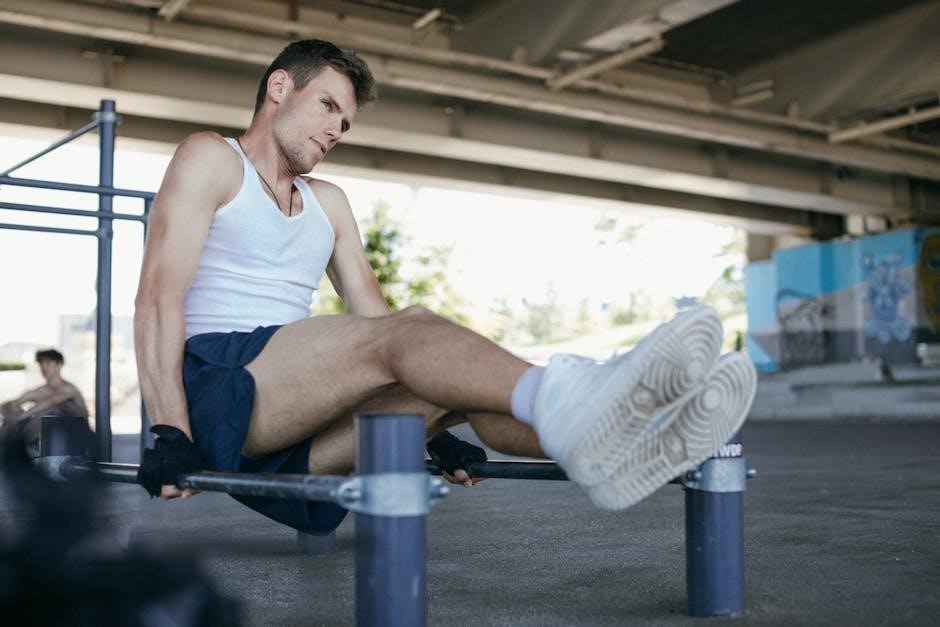
The PDF thoughtfully integrates resources from influential figures and highlights the importance of exercises like triceps dips within calisthenics.
Resources & Influences (Steven Low, Emmet Louis, Tom Merrick)
This program doesn’t exist in a vacuum; it’s built upon the solid foundation of knowledge shared by leading calisthenics experts. The PDF explicitly acknowledges and incorporates resources from Steven Low, known for his detailed understanding of progressive overload and skill acquisition. Emmet Louis’s contributions, particularly regarding handstand form and correcting common issues like an arched back, are also prominently featured.
Furthermore, the program heavily utilizes Tom Merrick’s extensive mobility work, specifically referencing his comprehensive mobility video. The creator demonstrates respect for these individuals by directly sourcing and crediting their work, creating a valuable resource for trainees. This collaborative approach ensures the program is grounded in proven methodologies and offers a well-rounded learning experience, benefiting from the collective wisdom of the calisthenics community.

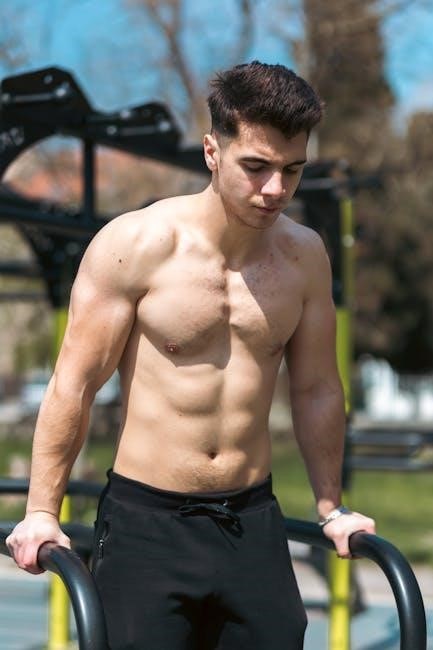
Triceps Dips as a Calisthenics Exercise
While not explicitly detailed within the core routines of this PDF, triceps dips represent a highly effective calisthenics exercise that complements the overall training philosophy. They serve as an excellent pushing movement, targeting the triceps brachii, but also engaging the chest and shoulders to a lesser extent.
Dips can be scaled for various skill levels, from assisted dips using bands or a spotter, to weighted dips for advanced trainees. Integrating dips into a push/pull split, particularly within the ‘mass-oriented’ section for advanced individuals, would be a logical progression. They provide a valuable alternative or supplement to push-ups, contributing to upper body strength and hypertrophy. The PDF’s emphasis on foundational movements makes dips a natural fit for a comprehensive calisthenics program.
No Responses